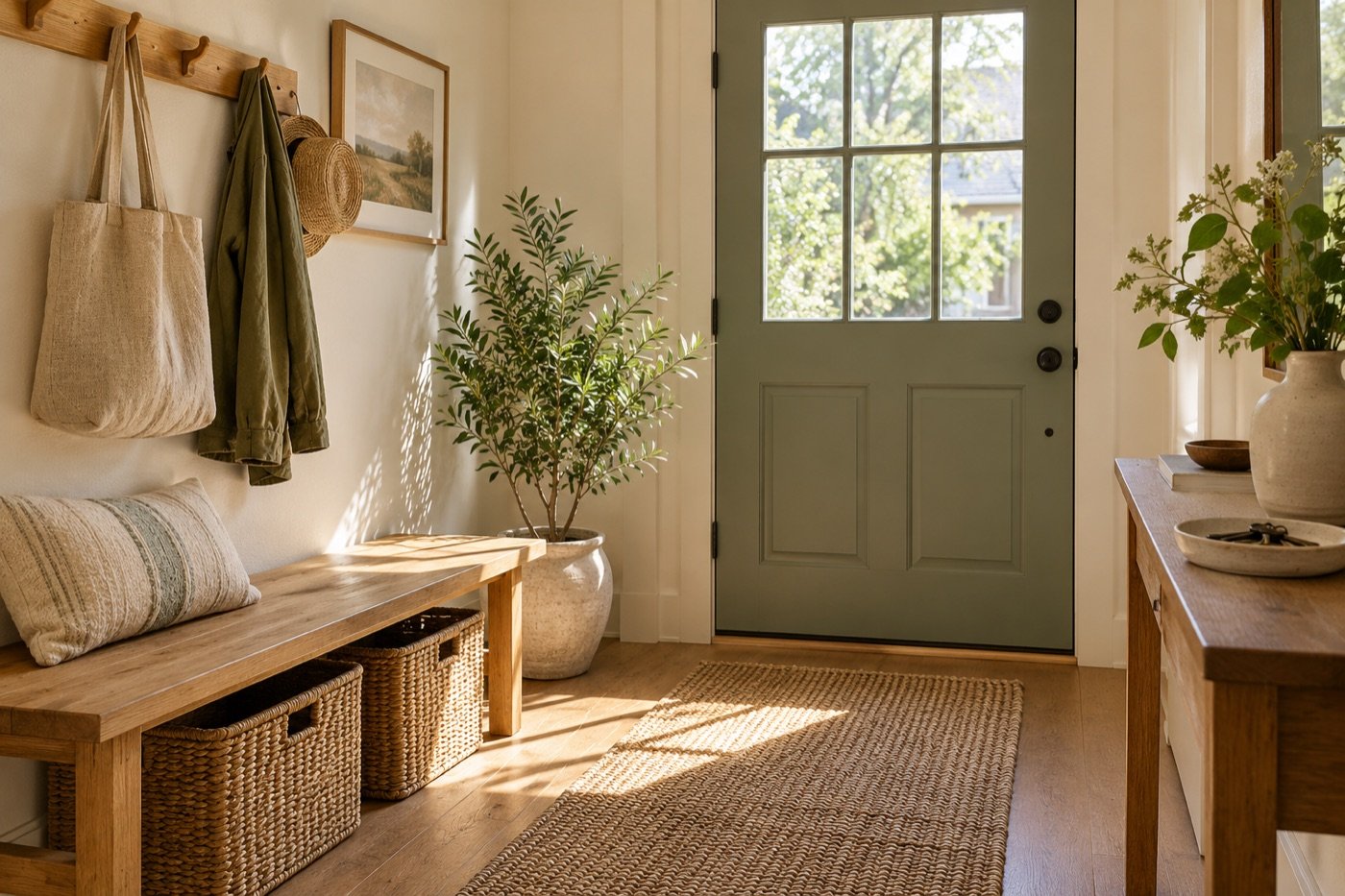
When a home has no dedicated entryway, bags and shoes often land on the nearest chair. A landing zone can be a small section of an existing room, provided it supports the arrival routine without taking over the route through the home.
Map what happens when you arrive
Walk in carrying the items you normally bring home. Notice where you need to turn, close the door, and put things down. Include the movement of everyone who shares the space rather than measuring only an empty room.
Choose the smallest group of belongings that needs an immediate place: keys, an everyday bag, and current shoes might be enough. Keep occasional equipment in its main storage area so the landing zone does not become general overflow.
Borrow an existing surface
A corner of a console, a low shelf, or an existing cupboard can work. Define the area with a small tray or a consistent placement rule. Avoid taking over a surface that already has an important function, such as a kitchen preparation area or a shared work desk.
If the only available surface is shared, choose a portable tray that can be moved to a proper storage location after arrival. The tray should simplify a transition rather than become a pile that moves from room to room.
Keep routes and doors clear
Do not place baskets, shoes, or bags in door swings or along the route needed to leave the home. Keep access to exits clear. The U.S. Fire Administration’s home escape guidance is a useful reference when thinking about routes through your home.
Check the arrangement at the time it is most crowded, not just immediately after tidying. If several people return at once, a location that works for one bag may not be practical for the household.
Use a departure check
Before leaving, take the belongings assigned to the landing zone and return anything unrelated to its usual room. After coming home, move items that need longer-term storage rather than adding them to the daily group.
For children or anyone with limited reach, choose a location they can use comfortably. Do not put heavy storage above a place where someone sits or removes shoes without appropriate installation and support.
Review what keeps escaping
If belongings repeatedly appear beside the assigned area, check whether the area is too small or too inconvenient. Adjust the location before adding rules. Our small entryway guide offers a step-by-step starting point.
Leave a Reply