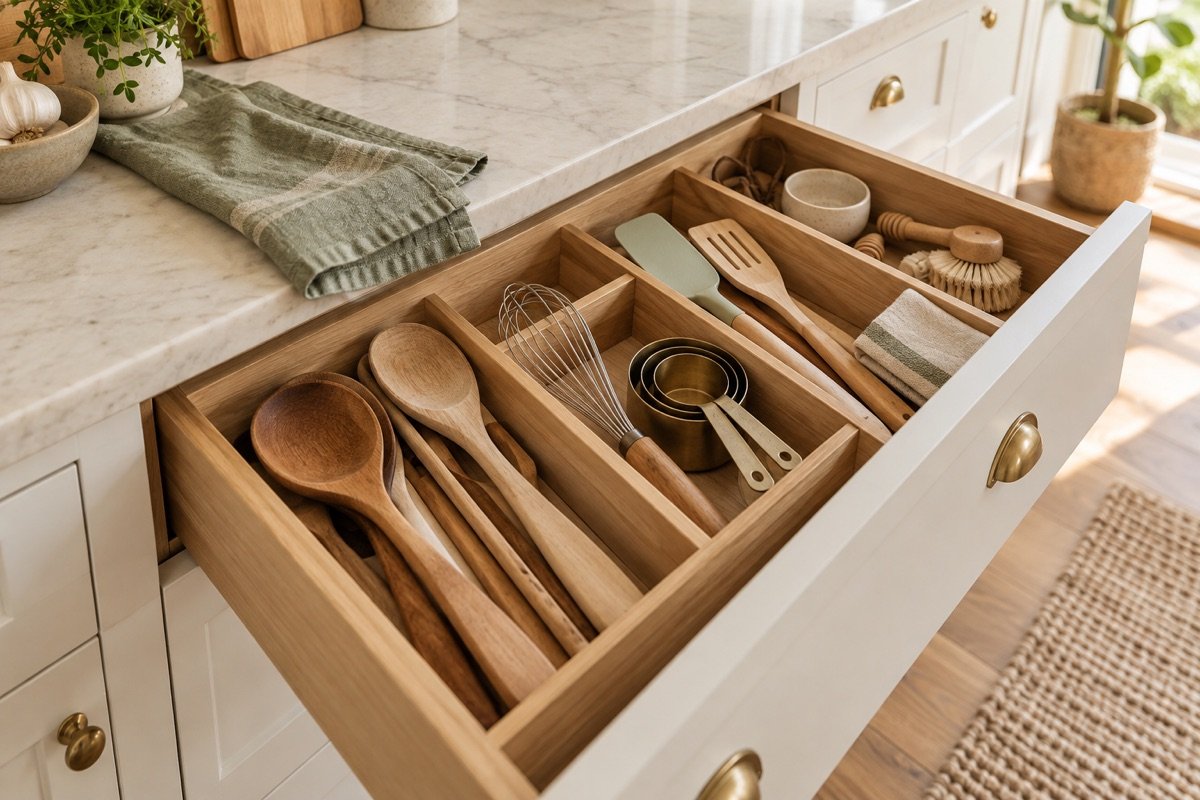
An organized kitchen drawer should make it easy to find a tool and just as easy to put it back. The most useful arrangement is usually based on how you cook, rather than on matching containers. Start with one drawer and use the storage you already have before buying dividers.
Choose a drawer with a clear job
Pick a drawer that causes a specific problem: utensils tangle together, measuring spoons disappear, or the drawer will not close. Name its main job in a sentence, such as “tools I use while preparing dinner.” That sentence gives you a practical test for what belongs there.
Do not empty the whole kitchen at once. Put the contents of that single drawer on a clear work surface and keep the project small enough to finish. If the drawer contains sharp objects, handle and store them with appropriate guards or a purpose-built insert. A loose knife should not be hidden under other utensils.
Sort by task instead of appearance
Group tools by what you do with them. Measuring tools can stay together; stirring tools can form another group. Separate items that belong near a different work area. A corkscrew might make more sense near glasses than beside a vegetable peeler.
Set aside broken items and duplicates for a separate decision. Owning two spatulas may be useful when cooking several dishes, while five nearly identical gadgets may be taking space you need. Decide based on your meals and household size, not a fixed number from someone else’s kitchen.
Measure the usable interior
Measure width, depth, and the clearance above the drawer contents. Include any screws, slopes, or runners that reduce the usable area. Tall tools can catch on the cabinet above even when they fit inside the drawer itself. Check that the drawer closes smoothly before filling it.
Arrange the empty groups in place first. Use a small tray you already own for items that tend to slide around. Any reused container should be clean, stable, and free from rough edges. Avoid overfilling it: if retrieving a tool requires lifting out several others, the group needs more room or fewer items.
Put frequent tools within easy reach
Place the tools used most often toward the accessible part of the drawer. Keep occasional items behind them, provided they remain visible and do not obstruct closing. Leave enough space to grip each tool without forcing your fingers between tightly packed handles.
Test the layout by preparing an ordinary meal. Pay attention to where you instinctively return each item. If several people use the kitchen, ask them to try it too. A system only one person understands will need constant correction.
Use a reset rule
Choose one simple rule: everything returns to its assigned group when dry and ready to store. Do not turn the drawer into a temporary holding area for mail, spare batteries, or unrelated objects. Give those things a separate home.
Review the drawer after a week. If one section is always crowded, redistribute space rather than immediately purchasing another organizer. Remove items you discovered you never reach for, or move them to occasional-use storage. Labels can help a shared household, but use a few clear task names rather than a label for every utensil.
When a divider is worth buying
Buy a divider when you know which group needs a boundary and have measured the space it needs. Check its dimensions and cleaning instructions. A simple arrangement that survives a rushed cleanup is more useful than a perfect-looking drawer that takes several minutes to put back together.
Further reading
For related official guidance to consider alongside this organizing project, see EPA: reducing, reusing, and recycling at home.
Continue exploring
Next, read our guide to a cupboard system for food containers and lids, or browse all 50 home guides.
Leave a Reply